Interlude: Wish
S1I2

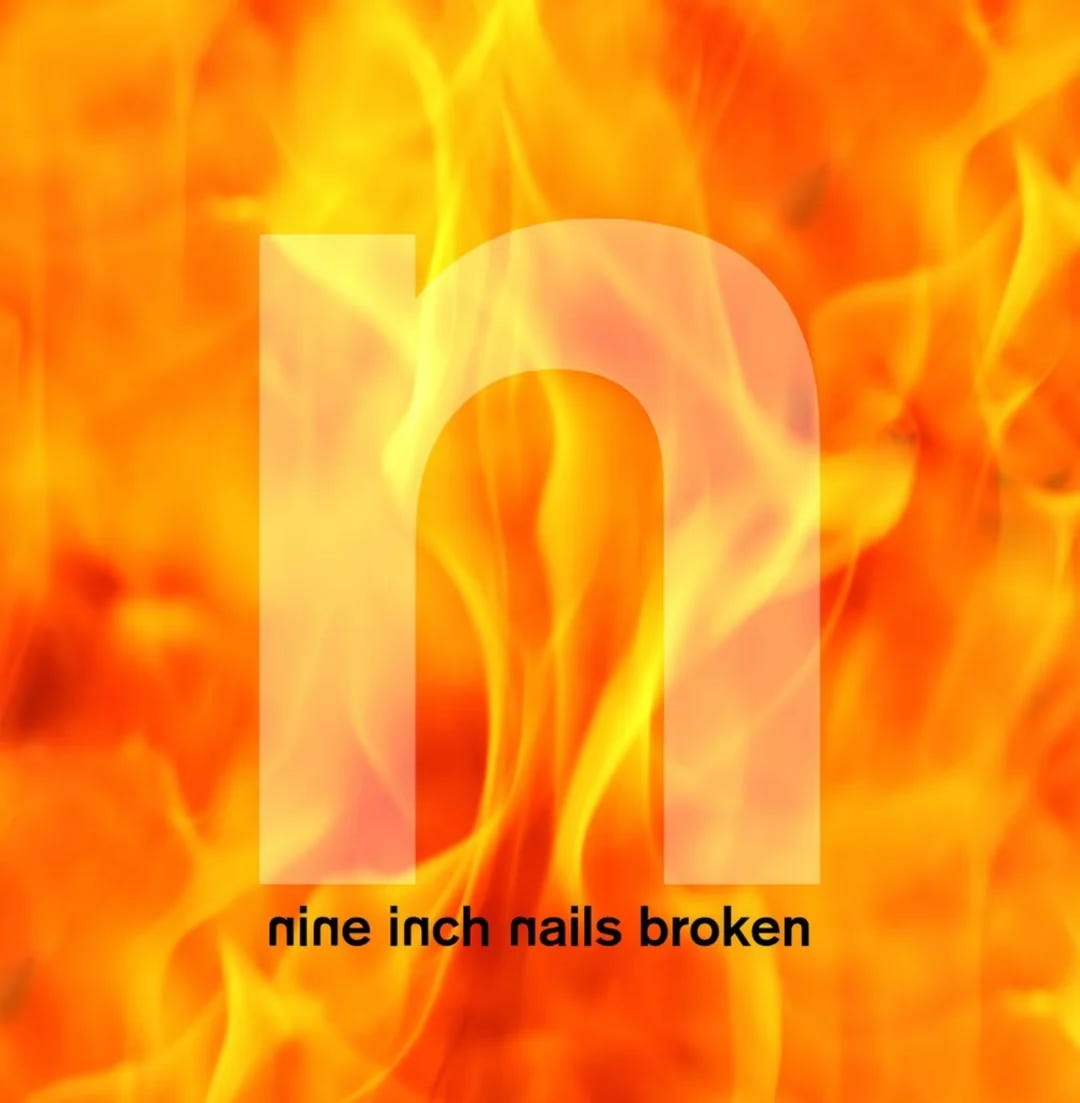
Broken - Nine Inch Nails
(Yorktown 1992)
The small orange postcard with black type arrived only after a self-addressed, stamped envelope had been sent off. It is hard, in retrospect, to explain the bonkers trust in invisible systems that it takes to take an envelope, write your own address on it (pausing to wonder if you should write a return address - the same one?), putting a stamp on it, and then putting that envelope into another one addressed to a PO Box in some town that was definitely not where the musician you were trying to contact lived. We would do these, “SASE’s” for all kinds of things: contests learned about in television commercials; orders from single page catalogues in the backs of magazines; or in this case, the liner notes of an album from 1989. With every SASE was a little prayer that literally anything would happen at all as a result. Maybe you’d get what you hoped for. Maybe you didn’t know what to hope for. Did Trent Reznor of Nine Inch Nails (NIN) make and maintain a newsletter? Was there a fan club run by an enthusiastic Clevelander who received these envelopes inside envelopes and filled it with dreams and sent it back? (Should I have put two stamps on it so it could carry more dreams?) The expectation was never less than 6-8 weeks but we never got our hopes up for any response under three months. In fact we didn’t have our hopes up at all that we would ever receive a response. Like standing in line for the Ticketmaster counter at a grocery store for tickets at the time, you simply participated and got what you got.
So when, 18 months later, anything came in the mail at all it was a sweet sweet surprise. That it was a postcard and not my SASE returned to me was totally fine and forgiven and whatever it meant this PO Box had a pulse. It was a simple orange postcard, weathered by the US Postal Service and had a simple quote on it under a big lowercase N: “The slave thinks he is released from bondage only to find a stronger set of chains.” The back contained my address (Hand written! Maybe by Trent? Surely not.) and an absolutely microscopic brief announcement that a new NIN work was coming soon, an EP, and you could order some NIN stuff ahead of it. I ordered a t-shirt and a poster. How? Well I had to get my Mom to write a check and stick it in another envelope and mail it off to the address provided - which was definitely a different address than I mailed before as this one was in California. The shirt and poster would arrive months and months before the EP came out. I had this long fiery poster of the simple lowercase N and that same quote 1/4 from the bottom hanging in my room feeling like the most up to date, hip dude on the planet and certainly in Yorktown, VA by NIN standards. The quote sounded so smart and sinister and badass.
So much of the wild truth was hidden to me on how my SASE turned into that postcard. (Let’s be clear, as a white male only child at 15 most wild truths were hidden from me.) I didn’t know the PO Box I’d sent it to was at a record label that was not the same record label this forthcoming work would come out on. Who knows if a box of SASEs had been collected, perhaps transcribed into a database (by hand) and turned over to the artist before the label could prevent it. Who knows if said old record label would sell my address to any sort of list-buying firm for endless junk mail but certainly no more than I was already destined for having signed up for Columbia House and other clubs under multiple aliases. I certainly didn’t know about the animosity, the label jumping, the record contracts, the jostling for creative control. I had no clue that the quote I thought was so badass from the postcard and the poster was a not-at-all veiled reference to NIN’s recording contract and their struggles with TVT Records.
In fact, I didn’t know much about Trent Reznor at all. What I did know was mystifying and tantalizing. I knew he had toured on the back of the first album, Pretty Hate Machine, whose liner notes had the address. I’d seen the occasional photos of he and others draped in unspooled tape and awkwardly caught by the camera leaning on or smashing a guitar or keyboard. A snippet of an interview might follow but largely it was driven by the press releases TVT put out (and those were few). As that album picked up popularity and the participation in the first Lollapalooza grew in infamy (including playing in daylight!), interviews and appearances began to show up in magazines and MTV news clips. I would collect articles and re read them dozens of times before they’d be taped up on my wall or closet door. I probably had read a full 20 minutes of direct quotes - which doesn’t sound like much, and isn’t. But you subsist on what you subsist on when you have a favorite band and the internet was only recently existing. To that point, AOL had a small subthread community for NIN but you could consume its speculation in an afternoon and repeatedly checking it didn’t help except for the occasional spotting of a new interview and the name of the magazine where I could go hunt it down - probably at a Waldenbooks, Mother’s Records in Hampton, Fantasy in Newport News, or later Peaches in Richmond, VA or Tower Records in DC. Fantasy also had intensely overpriced bootleg CDs of live shows - or should I say, “live show” at that point for NIN that some Italian company put out (if their liner notes were to be believed); the audio quality was horrible and of course I bought it.
From the vantage point of the average fan, the EP Broken would arrive on Compact Disc in the fall of 1992 with 92 empty tracks after it’s initial 6 tracks and then two “hidden” tracks would play (a Queen cover and a sort-of self cover of a song Trent had created for the Martin Atkins collective band Pigface). These songs would play if you simply left the CD player alone long enough- or you could get to them quicker (?) by rapid-fire “next”-ing the button. It was a clever use of the medium from a band who would be known for cleverly using mediums for decades. But as anyone who even ticks one notch over the “average fan” scale, this was not the only format for those two tracks. Some CD’s, in completely mystifying distribution, did not have the 99 tracks and simply had 6 with the extra two songs on the most adorable and fantastic tiny CD that slid into its own little sleeve and was included in the environmentally friendly digi-pack cardboard packaging. It looked like the CD analog to a full sized record compared to a 45 (and subsequent vinyl releases had exactly that same trick within the package). It was glorious and the only way to know if a given copy of Broken had the mini disc was to open the plastic which meant, yes, you were just guessing. Eventually there would be some tricks: security conscious indie record stores who removed discs from packages so they couldn’t be shoplifted by browsers meant you could find out if that copy had the minidisc; later in the 90’s as used CDs were sold more frequently you could find out if a used copy had it before the buy. (Savvy record stores of either or both persuasions knew better than to put those with the minidisc out on the floor - and who would sell theirs? I did manage to find one this way in the late 90’s.) What we could all learn later thanks to endless cataloguing and the internet was that only the first 250,000 copies had that little wee disc inside and that every other copy that would hit the streets in subsequent shipments in the coming weeks and years would be the “99 track” version. I ended up owning both versions as a teen and used my 99 track packaging as wall art, splayed open its three directions.
The music itself? Suddenly harder, more aggressive, brutal and (again) a direct reaction to things early fans had no clue about at the time. But it worked out and helped solidify and root NIN in the harder side of the spectrum while maintaining a connection to the more melodic and keyboard-centric first album. You can dance to some of Broken but it’s more mosh pit elbows than sad goth jives. This was in some ways a complete refit and new direction - or at least a delightful warning that Nine Inch Nails could go any f’ng direction it wished, thank-you-very-much. Is it a Sophomore Album in the way we always like to talk about it? No and yet also yes as it totally obliterates the concept. All future NIN releases can trace roots to both Broken and Pretty Hate Machine but you have to acknowledge both.
Not nearly as long later more legendary, weirder, and wilder things would happen and sneak out in interviews and lore about the Broken EP. Where it was recorded (the Sharon Tate murder house), how it was sort-of promoted (a long and disturbing performance art piece traded in hushed VHS tapes), and then what else it would create in a companion EP of remixes called Fixed. We didn’t know (How could we?) that a full-sized album of NIN was being created in the background for release less than two years later and would change the trajectory of the band, fans, experience, everything in The Downward Spiral. In retrospect, the wait between Pretty Hate Machine and the Broken EP would be nearly twice longer and the more agonizing one as the interest grew, the animosity between label and artist grew, and the official communication lessened.
But for a teen, bedecked in dyed black hair and a black shirt with puffy white NIN in the center, running out to the mailbox and seeing that postcard lying inside, it was a complete change of fortune. It was a golden ticket of information. That band you’d fallen in love with and in some ways had made part of your identity in the absence of more information, was alive. Alive and creating. And they wanted you to know that they knew you were there and waiting.
Your prayers, and self addressed stamped envelope, had been answered.